The Ultimate Travel Packing Guide for 2026 – Pack Light, Travel Smart, Stress Less
Our team has collectively taken over 400 flights in the past three years — many of them with only carry-on luggage. We have learned through painful experience exactly what to pack, what to leave at home, and which gear genuinely earns its place in a travel bag. This is the packing guide we wish we had read at the start.
Overpacking is the most common travel mistake — and the one with the most consistently negative impact on the trip experience. A heavy bag means checked luggage fees, waiting at carousels, strained shoulders, limited mobility in cities and constant anxiety about what is in it. Almost every experienced traveller looks back at their early travel self and winces at the weight they used to carry unnecessarily.
This guide gives you a clear, practical framework for packing light without sacrificing comfort or preparedness. We cover the strategy, the gear recommendations, a complete packing list and the specific techniques that have transformed how we travel.
The Core Philosophy — Start With Less Than You Think You Need
The golden rule of travel packing is that you will use approximately 60% of what you pack on any trip. The remaining 40% travels with you, adds weight and takes up space, and returns home unused. The problem is that before you leave, you cannot predict which 60% you will use — so the temptation is to bring everything.
The solution is to start with a strict maximum and force yourself to choose. For trips of one to four weeks, a 20–26L backpack or a standard carry-on suitcase (55 x 40 x 20cm) is sufficient for everything you need if packed with purpose. Many experienced travellers use the same 20L kit for both weekend trips and month-long journeys — the key is versatile clothing and washing as you go rather than carrying more clothes.
The 10-Step Packing System That Actually Works
1
Lay everything out first — then cut it in half
Put everything you think you need on the bed. Then remove half of it. This sounds extreme but is consistently the approach experienced travellers use. Start with what you definitely need, not what you might need.
2
Build your clothing around a colour palette
Choose clothes in two or three complementary neutral colours — navy, grey and white work together universally. Every item should work with every other item, giving you maximum outfit combinations from minimum pieces.
3
Apply the 5-4-3-2-1 clothing rule
5 pairs of underwear, 4 pairs of socks, 3 tops, 2 bottoms, 1 jacket. This covers most trips up to two weeks with one laundry wash mid-trip. Merino wool items can be worn 2–3 times before washing, effectively multiplying your wardrobe.
4
Pack packing cubes — they genuinely work
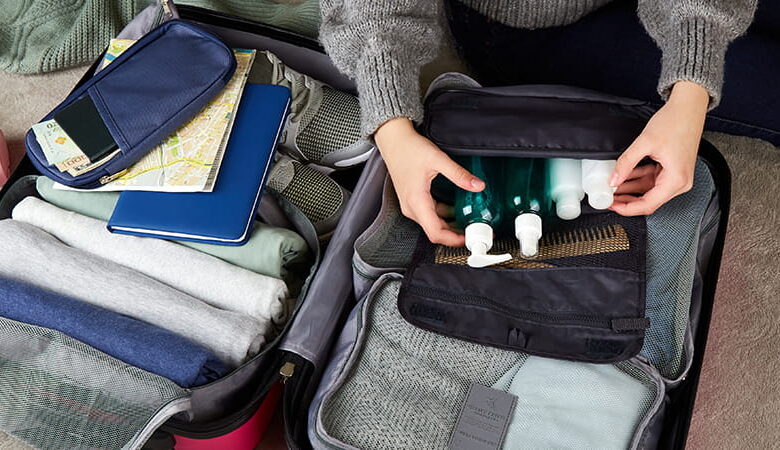
Packing cubes compress clothing, maintain organisation and make finding items in a full bag dramatically easier. We use one cube per category: clothing, electronics, toiletries. The compression versions reduce clothing volume by up to 30%.
5
Wear your bulkiest items on travel days
Jeans, boots, your heaviest jacket and your largest camera — wear these on travel days rather than packing them. What you wear does not count toward your carry-on weight allowance.
6
Use a single GaN charger for all devices
A 65W GaN charger with three ports replaces your laptop charger, phone charger and tablet charger in one device weighing 150g. This single swap saves 300–500g compared to carrying multiple chargers.
7
Transfer toiletries to small containers
Full-size toiletries are heavy and unnecessary for trips under three weeks. Transfer everything to 50–100ml travel bottles. For longer trips, buy locally — shampoo, sunscreen and toiletries are available everywhere.
8
Pack your bag the night before
Packing in a relaxed, non-rushed state produces significantly better results than last-minute packing. A packed bag you can reflect on overnight always reveals unnecessary items that get removed the next morning.
9
Digitise documents and backup everything
Scan and upload your passport, travel insurance, accommodation bookings and itinerary to cloud storage before travelling. Physical documents should be in your carry-on — never checked luggage. Digital backups mean no disruption if physical copies are lost.
10
Track what you used — and what you did not
When you return home, note honestly which items you used and which you never touched. This post-trip audit builds the most accurate packing list you will ever have — your personal packing history rather than a generic recommendation.
Best Packing Gear — Our Recommendations
Packing Cubes — Peak Design Packing Cube Set
Peak Design’s packing cubes are the best available — flat compression reduces volume by up to 50%, the clamshell opening provides full access to contents, and the build quality is outstanding. The set of three cubes covers all packing categories in most carry-on bags. Price: $80 for a set of three.
Travel Towel — Rainleaf Microfibre Travel Towel
A microfibre travel towel dries in 20 minutes versus 4 hours for a cotton towel and weighs 120g versus 500g+. Essential for hostels, beaches and destinations where towels are not provided. Price: $18–$25.
Toiletry Bag — Bagsmart Hanging Toiletry Bag
A hanging toiletry bag that unfolds to hang from any hook transforms bathroom counter organisation in hotels and hostels. The Bagsmart version has excellent compartmentalisation and a waterproof lining. Price: $22.
Packing Bottles — Matador FlatPak Toiletry Bottle Set
The Matador FlatPak bottles are the cleverest travel toiletry containers available — they flatten as they empty, taking minimal space in your toiletry bag. The silicone construction is leak-proof and airline compliant. Set of 4 for $30.
Luggage Scale — Etekcity Digital Luggage Scale
A $15 luggage scale eliminates the anxiety of overweight bags at check-in. Weigh your bag at the hotel before departure and remove items if needed — infinitely preferable to paying $50 overweight fees or repacking at the check-in desk.
The Complete Tech Packing List for Travellers
| Item | Weight | Essential? |
|---|---|---|
| Laptop + charger cable | 1.4–1.8 kg | Yes (nomads) |
| Anker 735 GaN 65W charger (replaces 3 chargers) | 150g | Yes |
| Anker 521 Power Bank 10,000mAh | 230g | Yes |
| USB-C hub (Anker 655) | 120g | Yes (MacBook) |
| Universal travel adapter | 200g | Yes |
| Noise cancelling headphones | 250g | Recommended |
| Kindle Paperwhite | 200g | Recommended |
| Cable organiser (Bagsmart) | 180g | Yes |
| USB-C cables x3 | 90g | Yes |
| AirTag x2 (checked bags) | 22g | Yes |
| Total tech weight | ~3.0 kg |
Carry-on only strategy: The single most liberating travel decision you can make is committing to carry-on only travel. You save checked luggage fees ($30–$80 each way), eliminate baggage carousel waiting time (20–45 minutes per flight), remove the risk of lost luggage entirely, and maintain complete mobility from plane door to destination without wheel-dragging. For most trips of up to three weeks, carry-on only is entirely achievable with the packing strategies in this guide.
Packing for Different Trip Types
Beach Holiday (7–14 days)
The lightest packing scenario — beachwear is compact, casual and informal. Three swimwear sets, three casual tops, two light shorts or trousers, one light layer for evenings and flip flops worn all day cover most needs. Sunscreen is heavy — buy a small amount for the flight and purchase the rest locally. Total bag weight target: 7–9kg.
City Break (3–7 days)
Slightly smarter clothing required for restaurants and attractions. The formula is the same core clothing with the addition of one smart outfit (one dress or chinos and a shirt). A compact crossbody bag or daypack for sightseeing replaces a large camera bag. Total bag weight target: 6–8kg.
Business + Leisure Mix
The most challenging packing scenario — requires smart professional clothing that also works for leisure. The solution is versatile pieces: a navy blazer over jeans looks appropriately smart for most business casual situations while remaining comfortable for evening dining. Wrinkle-resistant fabrics are essential. Total bag weight target: 8–10kg.
Digital Nomad Long-Term (1–12 months)
Long-term nomads effectively live from their bag — the key insight is that you are always within reach of shops and laundry services. Pack the same amount as a two-week trip and replenish locally as needed. Merino wool clothing that washes and dries overnight is the most practical fabric for extended travel. Total bag weight target: 8–12kg including full tech setup.
Frequently Asked Questions
How do you pack for two weeks in a carry-on bag?
The key is the clothing formula — five underwear, four socks, three tops, two bottoms, one jacket — and doing one laundry wash mid-trip. Use merino wool where possible (it can be worn multiple times before washing), pack packing cubes to compress clothing, and wear your bulkiest items on travel day. With discipline, two weeks in a carry-on is entirely comfortable. Our team does this routinely for trips of up to three weeks.
What are the best packing cubes in 2026?
Peak Design packing cubes are the premium choice — the flat compression and clamshell access are genuinely best-in-class. For a more affordable option, the Amazon Basics packing cube set offers excellent value and solid construction. Compression cubes from Eagle Creek are a strong mid-range choice. Whichever brand you choose, packing cubes of any quality will improve your packing significantly over no cubes at all.
Should I use a backpack or a suitcase for carry-on travel?
Both work well — the choice depends on your travel style. Backpacks are better for active travel with significant walking, cobblestone cities, and destinations without smooth floors. Suitcases are better for business travel, city breaks with good pavement infrastructure, and anyone with back or shoulder issues. A hybrid option — a backpack with a suitcase-style opening and wheels — like the Osprey Farpoint 40 or the Tortuga Setout offers the best of both approaches.
Final Verdict
The transformation from heavy checked luggage to light carry-on travel is one of the most consistently rewarding changes any frequent traveller can make. It requires discipline at the packing stage but pays dividends every day of every trip — in mobility, in savings, in freedom and in the simple pleasure of not having to manage a heavy bag through airports and unfamiliar streets. Start with the 5-4-3-2-1 clothing rule, invest in good packing cubes and a GaN charger, and commit to one carry-on-only trial trip. You will almost certainly never go back to checking bags again.